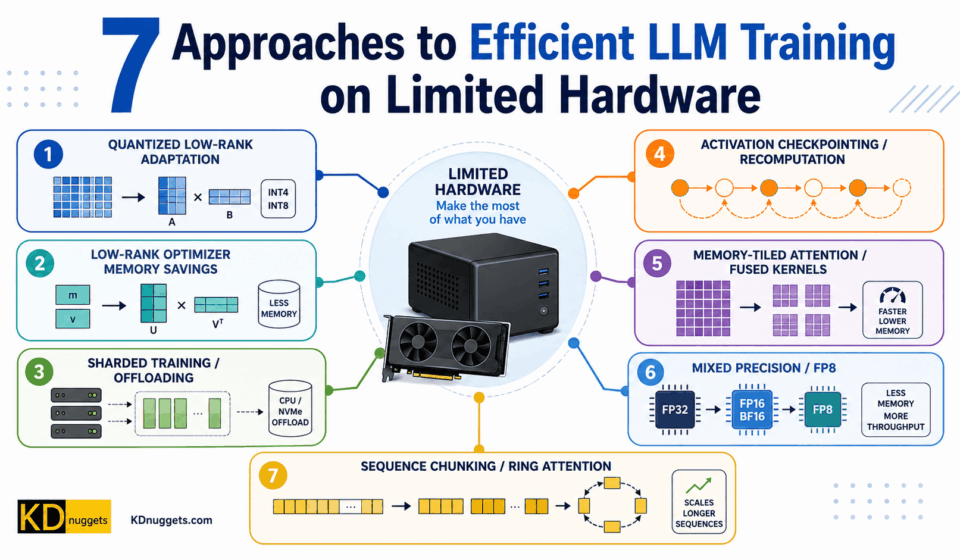

Training large language models typically demands massive GPU clusters, but that doesn’t mean you need a data center to get started. With the right engineering techniques, it’s possible to train LLMs on consumer-grade GPUs without running out of memory. Below are seven approaches that help squeeze more out of limited hardware.
1. Gradient Checkpointing
Gradient checkpointing trades compute for memory. Instead of storing all intermediate activations during the forward pass, it saves only a subset and recomputes the rest during backpropagation. This significantly reduces memory usage at the cost of additional computation, making it feasible to train larger models on smaller GPUs.
2. Mixed Precision Training
Mixed precision training uses lower-precision formats (like FP16 or BF16) for most operations while keeping some parts in FP32 for stability. This cuts memory consumption and can speed up training on GPUs that support these formats, all without sacrificing model accuracy when done correctly.
3. Gradient Accumulation
Gradient accumulation allows you to simulate a larger batch size than what fits in memory. By accumulating gradients over several mini-batches before updating the model weights, you effectively increase the batch size without increasing memory usage. This is especially useful when memory is the bottleneck.
4. Model Parallelism
Model parallelism splits the model across multiple GPUs. Each GPU holds a portion of the model’s layers or parameters, and they work together to process the data. This approach enables training of models that are too large for a single GPU, though it requires careful implementation to manage communication overhead.
5. ZeRO Optimizer
The ZeRO (Zero Redundancy Optimizer) family of techniques partitions optimizer states, gradients, and parameters across multiple GPUs. This eliminates memory redundancy and allows for training much larger models on the same hardware. ZeRO stages offer different trade-offs between memory savings and communication costs.
6. Offloading
Offloading moves tensors from GPU memory to CPU memory when they are not actively needed. This frees up valuable GPU memory for the parts of the model that are currently in use. While offloading can introduce latency, it’s a powerful way to train larger models on limited GPU resources.
7. 8-bit Optimizers and LoRA
Using 8-bit optimizers reduces the memory footprint of optimizer states by quantizing them to 8-bit integers. Similarly, LoRA (Low-Rank Adaptation) freezes the original model weights and injects small, trainable rank decomposition matrices. Both techniques drastically lower memory requirements, making it possible to fine-tune large models on consumer GPUs.
Putting It All Together
These seven techniques can be combined to further reduce memory usage. For example, you might use gradient checkpointing alongside mixed precision and gradient accumulation to train a model that would otherwise be impossible on your hardware. Experimenting with different combinations will help you find the best setup for your specific GPU and model size.
